
A brown dog resting comfortably on a cushion
The K-10 journal · Kathleen Lawton

Thoughts
of a Trainer.

A little perspective.
A better life with your dog.

From Kathy’s desk

Understanding starts
with curiosity.

Read Kathy’s thoughts on training and life with dogs. Select any numbered article to unfold the full story, right here.

Understanding your dogWhy Does My Dog Know It at Home but Not Somewhere Else?Kathleen LawtonRead articleClose article
Open this article’s own page ↗

Have you ever taught your dog a behavior at home and thought, “They’ve got it!”—only to try the same behavior somewhere else and discover that your dog suddenly seems to have forgotten everything?

Don’t worry. Your dog probably hasn’t forgotten. What you are seeing is a very important part of dog training called generalization.

What Is Generalization?

Generalization is the ability to perform a learned behavior in different situations, environments, and circumstances. Dogs are very good at learning specific associations. This can also mean that they may learn that a particular behavior applies only in a particular place or situation.

For example, imagine you have taught your dog to sit when you say “sit” in your living room. Your dog sits beautifully every time.

Then you take your dog to the park and ask for a sit.

Your dog looks at you.

You ask again.

Your dog looks at you some more.

You might think, “But you KNOW how to sit!”

Your dog probably does—but the environment has changed.

At home, your dog has learned that the word “sit” predicts a particular behavior in a familiar environment. At the park, there are new smells, sounds, people, dogs, and other distractions. Your dog needs to learn that the same cue and behavior apply there too.

Dogs Don't Automatically Generalize

One of the biggest misunderstandings about dog training is assuming that once a dog learns a behavior in one place, they will automatically perform it everywhere.

Dogs don't necessarily see things that way. Think about teaching your dog to walk nicely on a leash in your driveway. The driveway may be quiet and familiar. Your dog has few distractions and has had lots of practice there. Now move to the sidewalk. Suddenly there are cars, people, squirrels, dogs, bicycles, interesting smells, and all kinds of new things happening.

The skill hasn't necessarily disappeared. The environment has changed. Your dog needs practice learning that the behavior still works in this new situation.

Generalization Takes Practice

A good way to help your dog generalize a behavior is to gradually practice it in different locations.

For example, if you're teaching a reliable sit, you might practice:

In the living room

In the kitchen

In the backyard

In the driveway

On the sidewalk

In a quiet park

Around familiar people

Around unfamiliar people

Around other dogs, when appropriate

In places with increasing levels of distraction

You don't need to move immediately from your quiet living room to the busiest dog-friendly location you can find. Instead, think about small steps.

Change One Thing at a Time

When working on generalization, it can be helpful to change one variable at a time.

For example, your dog may know how to sit in the kitchen with you. Try practicing in another room. Once that is going well, try the backyard. Then perhaps practice while a family member is nearby. Later, you might practice somewhere outside the home.

Each new situation gives your dog another opportunity to learn that the behavior applies in different circumstances.

Don't Make It Too Difficult

Sometimes we accidentally make generalization harder than it needs to be. If your dog can perform a behavior perfectly in a quiet room, that doesn't mean they are ready to perform it in the middle of a busy park. When the environment becomes more distracting, your dog's ability to respond may decrease. He is not being stubbornness or disobedience. It simply mean that the training criteria need to be adjusted.

If your dog struggles, make the situation easier. Move farther away from the distraction, choose a quieter location, shorten the training session, or return to a behavior your dog knows well. Then build up gradually.

Generalization Works Both Ways

Generalization isn't just about locations. Dogs may need to learn that a behavior applies with:

Different people

Different equipment

Different surfaces

Different times of day

Different levels of distraction

Different distances

Different environments

Different types of rewards

For example, a dog may happily lie down on the carpet but hesitate when asked to lie down on a hardwood floor or outside on wet grass. Again, the dog isn't necessarily being difficult. The new situation may simply require additional learning and practice.

Think of Training as Building a Collection of Experiences

Rather than thinking, “My dog knows this behavior,” it can be more helpful to think:

“My dog has learned this behavior in this particular situation.”

Our goal is to gradually give our dogs many different experiences with the behavior. Each successful experience helps them understand that the behavior isn't limited to one specific place or circumstance. Eventually, the dog begins to understand that “sit” means sit—not just when we're standing in the kitchen.”

Be Patient

Generalization takes time. If your dog struggles in a new environment, try not to become frustrated. Instead, ask yourself: “What can I change to make this easier for my dog?”

Training should be a process of helping our dogs succeed, not simply testing whether they can perform a behavior under difficult circumstances. The more opportunities your dog has to practice a behavior successfully in different situations, the stronger and more useful that behavior becomes.

The Bottom Line

Teaching a behavior is only the beginning. Generalization is the process of helping your dog understand that the behavior applies in many different places and situations.

So the next time your dog sits perfectly in your kitchen but seems to have forgotten how to sit at the park, don't panic! Your dog may not have forgotten. They may simply be telling you:

“I've learned this here. Now you need to teach me that it works there, too!”
Understanding your dogPositive Reinforcement: What is it and Why does It WorksKathleen LawtonRead articleClose article
Open this article’s own page ↗

We have all been there. Your dog is barking at the window, chewing the TV Remote, or pulling you down the sidewalk like a runaway freight train. In those moments of frustration, it is easy to focus entirely on how to make them stop.

But what if the secret to a well-behaved dog isn’t stopping the bad behavior, but actively championing the good?

That is the core philosophy behind positive reinforcement dog training. Instead of using force, fear, or corrections to discipline a dog, positive reinforcement focuses on rewarding the actions you want to see again. It is science-based, humane, and incredibly effective.

Here is a breakdown of why this training method works so well and how you can start using it today.

What Exactly Is Positive Reinforcement?

In behavioral science, "positive" doesn't mean pleasant, and "reinforcement" doesn't just mean a treat.

Positive means adding something to the environment.

Reinforcement means increasing the likelihood that a behavior will happen again.

Put them together, and positive reinforcement means adding a desirable reward immediately after a behavior to ensure your dog repeats that behavior in the future.

Think of it like getting a paycheck. You go to work because you get paid. If your boss stopped paying you, you would eventually stop showing up. Your dog operates the same way. If sitting calmly by the door gets them a piece of delicious chicken, they are going to choose to sit by the door much more often.

Why Science Favors Rewards Over Punishment

Here is why positive reinforcement wins out:

It builds trust, not fear: Traditional corrections can cause a dog to associate the pain or fright with you or their surroundings, leading to anxiety and defensive aggression. Reward-based training builds a deep bond of trust.

Dogs learn faster: When a dog is stressed or scared, their brain shuts down the ability to process new information. A happy, motivated dog is a focused student.

It addresses the root cause: Punishment might suppress a behavior temporarily, but it doesn't teach the dog what they should do instead. Positive reinforcement gives them a clear alternative.

The 3 Golden Rules of Reward-Based Training

Starting out is simple, but consistency is key. Keep these three rules in mind to get the best results:

1. Timing is Everything

Dogs live in the present moment. You must reward your dog within 1 to 2 seconds of the desired behavior. If your dog sits, but you fumble in your pocket for a treat for ten seconds until they stand back up, you just rewarded them for standing, not sitting.

2. Treats have different values – use that.

A piece of dry kibble might work in a quiet living room, but it won’t cut it at a busy park. Use high-value rewards like small pieces of freeze-dried liver, dehydrated chicken, cheese, or for toy motivated dogs, even their favorite tug toy. Keep the pieces tiny—about the size of a pea—so your dog doesn't get full too quickly.

3. Capture the "Good" Moments

Don't wait for a formal training session to reward your dog. If you catch your dog lying quietly on their bed while you work, walk over and drop a treat between their paws. By "capturing" naturally good behavior, you teach them that being calm is highly rewarding.

Common Pitfalls to Avoid

Accidentally rewarding the wrong thing: If your dog whines at you and you hand them a toy to quiet them down, you have just reinforced the whining.

Phasing out treats too fast: Treats are not a bribe; they are payment. Keep the rewards frequent when teaching a new skill. Once the dog masters it, you can transition to a variable schedule (like a slot machine).

Expecting too much, too soon: If your dog can't do a "stay" in the kitchen, they definitely can't do it at the dog park. Start in low-distraction environments and slowly build up the difficulty.

A Happy Bond for Life

Positive reinforcement training isn't just about teaching your dog to sit or roll over. It changes the way you look at your pet. Instead of constantly monitoring them for mistakes, you find yourself actively hunting for the things they do right.

The result? A confident, happy dog who loves to learn, and a lifelong bond built on mutual respect.

Happy training!

Understanding your dogPuppy Socialization: Giving Your Puppy the Best StartKathleen LawtonRead articleClose article
Open this article’s own page ↗

If you've recently brought a puppy into your home, you're probably focused on the basics: potty training, chewing, sleeping through the night, and wondering if your puppy will ever stop putting everything in their mouth!

But there is another very important part of raising a puppy that I encourage every new puppy owner to think about from the very beginning: socialization.

At K-10 Dog Training, I believe puppy socialization is about much more than simply letting your puppy play with other dogs. It's about helping your puppy learn that the world is a safe, interesting place and giving them the skills they need to confidently navigate it.

What Does Socialization Really Mean?

When people hear the word socialization, they often think about taking their puppy to meet lots of people and lots of dogs.

While appropriate interactions with people and other dogs can certainly be part of socialization, there is so much more to it.

Your puppy is learning about the world every single day.

They are learning about:

Different people and voices

Children and adults

Other dogs and animals

Cars, trucks, bicycles, and other moving objects

Household appliances and unfamiliar noises

Different flooring and surfaces

Going for rides in the car

Veterinary visits

Grooming and nail care

New places and environments

Being alone for short periods of time

New sights, sounds, smells, and experiences

Our job is to help them experience these things in a way that builds confidence rather than fear.

Socialization Isn't About Saying Hello to Everyone

One of the things I really want puppy owners to understand is that your puppy does not need to greet everyone they see.

In fact, I love teaching puppies that they can notice people and dogs without necessarily interacting with them.

Imagine you're taking your puppy for a walk and another dog comes toward you.

Instead of automatically saying, "Go say hi!", we can teach your puppy to look at the other dog, remain calm, and then check back in with you.

That's a valuable life skill.

Your puppy is learning:

"I can see another dog without having to run over to them."

The same principle applies to people. We want puppies to learn that people are part of the environment—not that every person they see is an invitation for a greeting.

Pay Attention to What Your Puppy Is Telling You

One of the most important skills you can develop as a puppy owner is learning to read your dog's body language.

Sometimes a puppy who appears to be having fun is actually becoming overwhelmed.

Watch for signs such as:

Trying to hide or get away

Avoiding eye contact

Excessive barking

Trembling

Lip licking or yawning

Becoming unusually still

Refusing treats

Repeatedly trying to escape the situation

When we see these signs, it's time to slow things down.

Socialization isn't about forcing a puppy to "get over it." If your puppy is frightened by something, giving them more exposure at that moment isn't necessarily going to make them less afraid.

Instead, we want to create small, successful experiences.

Maybe we move farther away. Maybe we let the puppy watch from a safe distance. Maybe we leave and try again another day.

There is no need to rush.

Confidence Comes From Successful Experiences

I have always believed that training should help dogs feel successful.

That is especially important with puppies.

If we introduce something new and our puppy handles it comfortably, we can reward that experience. If something is too much, we can back up and make it easier.

Over time, those little successes add up.

A puppy who learns, "I can handle new things, and my person will help me when I'm unsure," is developing something much more valuable than obedience.

They are developing confidence and trust.

Don't Forget About Handling

Your puppy will eventually need to visit the veterinarian, have their nails trimmed, be groomed, have their ears examined, and be handled in ways they may not initially understand.

Why wait until you need to do these things?

We can begin preparing puppies by making gentle handling part of everyday life.

Touch a paw and offer a treat.

Briefly look at an ear and reward.

Gently touch their collar.

Practice having someone handle their body.

Keep it short. Keep it positive. And most importantly, pay attention to how your puppy is responding.

We want your puppy to learn that being handled doesn't have to be scary.

Safe Socialization Is Important

Puppies also need appropriate protection from illness while they're completing their vaccinations.

That doesn't mean they need to stay isolated from the world.

Talk with your veterinarian about your puppy's vaccination schedule and what experiences are appropriate for your puppy at each stage.

There are many ways to socialize a puppy safely.

You can introduce them to new sights and sounds from the safety of your home or vehicle. You can invite appropriate people into your home. You can introduce them to healthy, vaccinated dogs you know. You can carry your puppy through places where they can safely observe the world.

The goal is to provide experiences while still being responsible about your puppy's health.

Puppy Socialization Is Also About You

One of my favorite things about working with puppies is helping their people understand what their puppies are actually communicating.

Puppies don't come with an instruction manual.

Sometimes they're tired.

Sometimes they're overwhelmed.

Sometimes they're curious.

Sometimes they're simply being puppies!

Learning to recognize the difference can make life with a new puppy much easier.

That's why I don't look at puppy training as simply teaching a list of commands. I want to help you understand how your puppy learns, how they communicate, and how you can build a relationship based on trust and cooperation.

Socialization Doesn't Stop When Puppyhood Ends

Another important point: socialization isn't something you finish.

Your puppy doesn't graduate from socialization at a certain age and suddenly become a finished dog.

Dogs continue to learn throughout their lives.

As puppies grow into adolescents and then adults, they will encounter new situations. Their confidence may change. Something that didn't bother them at six months might suddenly be interesting—or concerning—at a year.

Continue exposing your dog to new experiences in a thoughtful, positive way.

Keep learning together.

The Goal Isn't a Dog Who Loves Everyone

I don't expect every dog to love every person.

I don't expect every dog to want to play with every other dog.

And honestly, that's okay.

My goal is a dog who can comfortably exist in the world.

A dog who can see another dog without needing to greet it.

A dog who can meet a new person without becoming overwhelmed.

A dog who can visit the veterinarian with less stress.

A dog who can experience something unfamiliar and look to their person for guidance.

Most importantly, I want you and your dog to develop a relationship where your puppy learns that you are someone they can trust.

Start Building That Relationship Today

Your puppy's early experiences matter.

You don't need to take your puppy everywhere or introduce them to everything at once. In fact, doing too much can be counterproductive.

Instead, look for small opportunities every day.

A new sound.

A new surface.

A calm person.

A new environment.

A brief car ride.

A few minutes watching the world from a safe distance.

Celebrate the little successes.

Those small moments are helping your puppy become the dog they will eventually be.

At K-10 Dog Training, my goal is to help you and your puppy get off to the best possible start—not by overwhelming you with a long list of commands, but by helping you understand your dog and build a relationship based on communication, trust, and positive experiences.

Because raising a puppy can be challenging.

It can also be one of the most rewarding experiences you'll ever have with a dog.

And you don't have to figure it all out by yourself.

Understanding your dogBeyond the "Pack Leader": Why Modern Dog Training Has Moved OnKathleen LawtonRead articleClose article
Open this article’s own page ↗

For decades, the standard advice for new dog owners was simple: you must become the pack leader. We were told to eat before our dogs, never let them walk ahead of us on a leash, and forcefully correct them to assert our "alpha" status. It sounded logical, but modern behavioral science has flipped this script entirely.

If you have been stressing over dominating your couch-loving pup, you can take a deep breath. No, you do not need to be a "pack leader" to your dog.

Here is a look at where the alpha myth came from, why it has been debunked, and what your dog actually needs from you instead.

The Origin (and Downfall) of the Alpha Myth

The idea of the "pack leader" came from early studies of captive wolves in the mid-20th century. Researchers observed unrelated wolves thrown together in artificial, confined environments. Unsurprisingly, these wolves fought for status, leading to the concept of a rigid, aggressive hierarchy ruled by an "alpha."

However, later studies of wild wolf packs revealed a completely different reality.

Wild packs are families: A natural wolf pack is simply a mom, a dad, and their offspring. The parents lead the pack not through physical domination, but because they are the parents guiding their children.

Dogs are not wolves: Dogs have evolved alongside humans for thousands of years. They are a completely different species with distinct social structures. Expecting a dog to view a human as a wolf boss is like expecting a house cat to treat you like a lion.

Because of this, major veterinary and behavioral organizations—including the American Veterinary Society of Animal Behavior (AVSAB)—have officially moved away from dominance theory.

Why the "Pack Leader" Mentality Can Backfire

Trying to enforce an "alpha" status often does more harm than good. When you use force, pinning tactics, or harsh corrections to "show them who is boss," you aren't teaching your dog how to behave. Instead, you risk creating:

Fear and Anxiety: Your dog stops doing the behavior simply because they are afraid of being hurt or intimidated.

A Breakdown of Trust: Dogs thrive on predictability. If their human companion unpredictably turns aggressive or forceful, it damages the bond between them.

Defensive Aggression: A dog who feels threatened or backed into a corner by a "dominant" owner may eventually feel forced to bite to protect themselves.

What Your Dog Actually Needs: A Benevolent Guide

If you aren't the pack leader, what are you? Think of yourself as a parent, teacher, and benevolent guide.

Dogs don’t want to rule your household; they just want to know what the rules are so they can feel safe. You can build a well-behaved, happy dog without a single ounce of intimidation by focusing on three core pillars:

1. Clear Boundaries and Consistency

Dogs love routine. You don't need to eat before your dog to show dominance, but you should teach them to sit politely before you put their food bowl down. Consistency gives your dog a sense of security.

2. Positive Reinforcement

Instead of punishing bad behavior, catch your dog being good. Reward the actions you want to see more of with treats, praise, or play. If your dog gets a piece of chicken every time they lie quietly on their mat while you eat dinner, they will choose to do it on their own.

3. Cooperative Care

Build a relationship based on mutual trust. Teach your dog that handling their paws, grooming them, and visiting the vet are safe, rewarding experiences rather than battles of will.

The Takeaway

Your dog knows you aren't a wolf. They don't need a dictator; they need a trusted friend who provides safety, clear communication, and plenty of love. When you swap the pressure of being an "alpha" for the joy of being a trainer and partner, you will find that your dog is much more eager to listen—and your bond will be stronger than ever.

Understanding your dogWhy You Shouldn’t Let Friends Treat Your Shy or Fearful DogKathleen LawtonRead articleClose article
Open this article’s own page ↗

If you have a shy or fearful dog, you may have heard well-meaning advice such as, “Let your friends give him a treat. Then he will warm up to your friend.”

It sounds harmless, right? But when we are dealing with a shy or fearful dog, having people offer treats is not the best approach. In fact, asking friends and family members to give your shy dog treats can make the situation more difficult.

Imagine being afraid of someone, but that person keeps approaching you with something you really want. You might take the treat because you want it, but that doesn’t necessarily mean you are comfortable with the person.

Dogs that do not feel comfortable around strangers can experience that same conflict. In fact we say they are conflicted. The dog may approach, take the treat, but then quickly retreat. To the person, it may look like progress: “See? He likes me!”

But the dog may simply be making a choice between something valuable and something scary. When someone offers a treat, a shy dog may move toward that person even though they would normally prefer to keep their distance or move farther away. This can put the dog in a difficult position which is very stressful for the dog.

The dog may approach to get the food and then find themselves closer to the person than they are comfortable with. If the person reaches toward them, tries to pet them, or becomes excited because the dog came closer, the dog may feel trapped.

Instead of learning to feel more comfortable around strangers, the dog learns: “When I approach people for food, they approach me.” That may actually make the dog less willing to approach people in the future.

So what do you do to help your shy dog feel more comfortable? Stand with your dog at a comfortable distance from the person. Remember – your dog chooses that distance. He needs to be far enough away that your dog is relaxed. If he’s comfortable, he will likely take treats. But instead of having your friend give the treat, you treat him. Keep these sessions short, but feed your pet repeatedly while the stranger is present. Use high value treats – something he may not get at any other time.

The message you are now giving your dog is, when that scary person is present, he stays away from me and good things happen – I get yummy treats. Repeated, this actually can change your dog’s view of the scary person.

Remember, the dog always decides how quickly or slowly he progresses as each dog is unique. Giving him the chance, you’ll likely see him be more comfortable at closer distances from the person. When the dog feels comfortable, he will, on his own, approach the person. Once the dog is willing to approach and indicate he’d like to interact with the person without the lure of a treat, that person can then treat the dog.

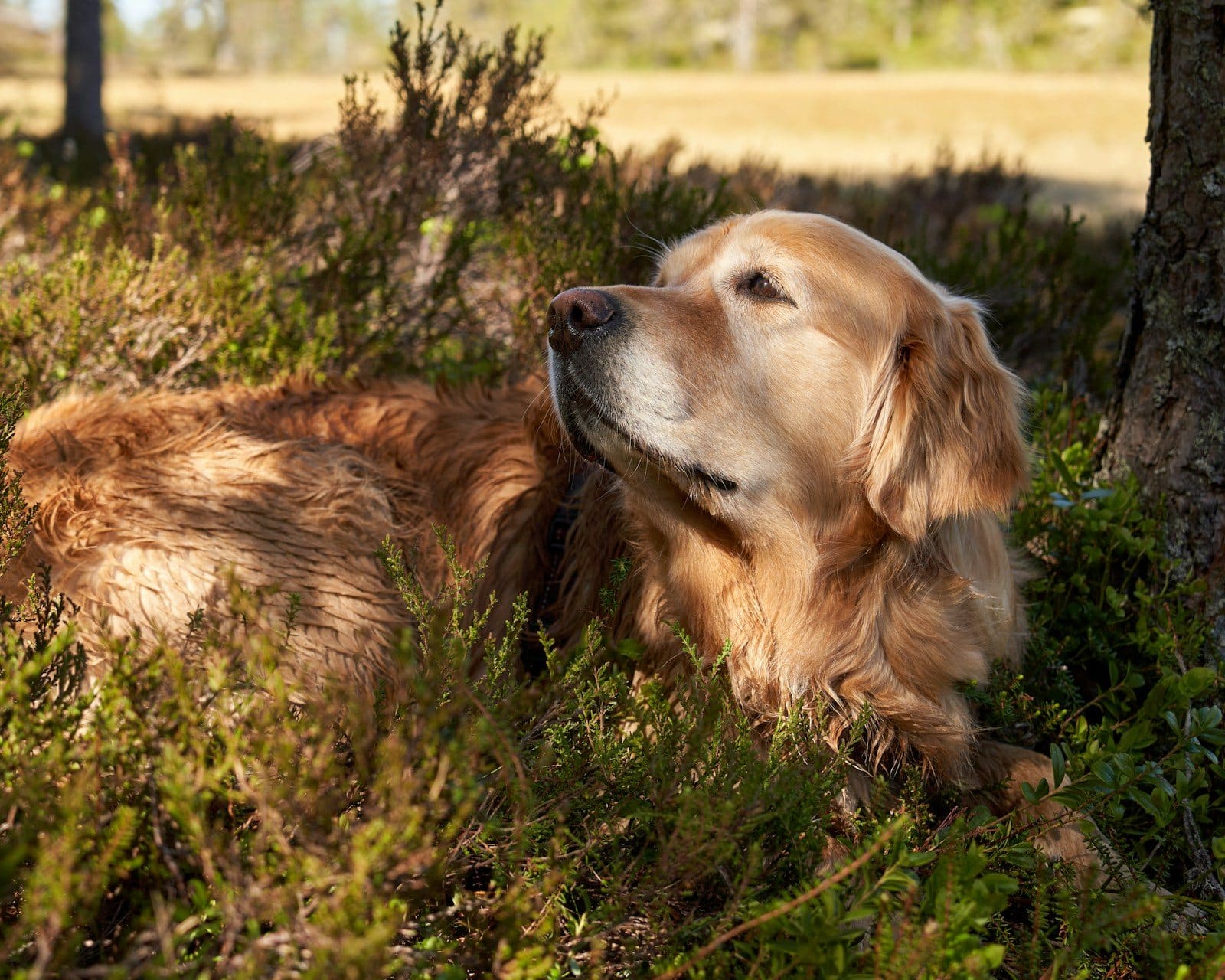
A golden retriever relaxing outdoors among green foliage
Put understanding into practice

Your dog’s story.
Your next step.

Let’s turn what you’ve learned into a thoughtful plan for life together.